After the shock of a collision, it’s common to wonder how it happened. Why didn’t the other driver slow down, stop at the red light, or stay in their lane? When it’s discovered they were texting, everything becomes clear.
Texting while driving does more than take someone’s eyes off the road. It disrupts their hands, their concentration, and their judgment. It pulls their attention away from everything that safe driving demands, often with devastating results.
Texting while driving accidents happen more often than many people realize. In fact, driver distraction is a leading cause of traffic collisions in the U.S. And because texting interferes with vision, focus, and physical control all at once, it’s widely considered the most dangerous type of distracted driving.
Key Takeaways for Texting While Driving Accidents
- Texting while driving involves visual, manual, and cognitive distraction all at once.
- Most states ban texting while driving, but laws vary in enforcement and penalties.
- Missouri now has a statewide hands-free law; Kansas enforces a primary ban on texting.
- Proving fault may involve phone records, vehicle data, or eyewitness testimony.
- A distracted driving crash can lead to lasting injuries and financial hardship.
- An experienced personal injury lawyer can help protect your rights and pursue full compensation.
The Real Danger Behind Texting While Driving
Texting while driving isn’t the same as making a quick glance at the GPS. It checks every box for dangerous distraction: your eyes, your hands, and your mind are pulled away from the road all at once.
According to the National Highway Traffic Safety Administration (NHTSA), sending or reading a text at 55 mph is like driving the length of a football field with your eyes closed. That moment of distraction can mean a catastrophic collision, often without any attempt to slow down or avoid impact.
In fact, texting while driving contributes to thousands of crashes each year. The Insurance Institute for Highway Safety (IIHS) and the Centers for Disease Control and Prevention (CDC) both rank it as one of the most dangerous forms of distracted driving, comparable in risk to drunk driving.
What Counts As Distracted Driving?
Many drivers assume distracted driving only applies to texting. But the reality is broader. The CDC categorizes distracted driving into three types:
- Visual: Taking your eyes off the road
- Manual: Taking your hands off the wheel
- Cognitive: Taking your mind off driving
Texting is especially dangerous because it involves all three at once. But distractions also include:
- Scrolling on a phone or adjusting music
- Interacting with GPS or apps
- Talking to passengers
- Eating or drinking
- Reaching for something in the car
- Looking at billboards or roadside events
Not every distraction leads to a crash. But when a driver chooses to text, they’re taking a calculated risk that someone else may pay for.
Texting and Driving Laws in the United States
Every state has laws aimed at reducing distracted driving, but enforcement and penalties vary widely. As of 2025, texting while driving is illegal in 48 states, plus Washington D.C., Puerto Rico, Guam, and the U.S. Virgin Islands. However, not all laws are enforced the same way.
Some key variations include:
- Primary enforcement: Police can stop drivers solely for texting.
- Secondary enforcement: Drivers can only be cited if stopped for another offense.
- Hands-free requirements: Some states go further, requiring full hands-free use of devices.
Missouri and Kansas: A snapshot
- Missouri: As of August 2023, Missouri banned all drivers from using handheld devices while driving, after years of limited enforcement that only applied to drivers under 21. This law is known as the Siddens Bening Hands-Free Law, and violations carry fines and points on the license.
- Kansas: Kansas bans all texting while driving and enforces it as a primary offense. Hands-free laws currently apply mainly to commercial drivers, but state officials have considered expanding these rules.
Liability in Texting While Driving Accidents
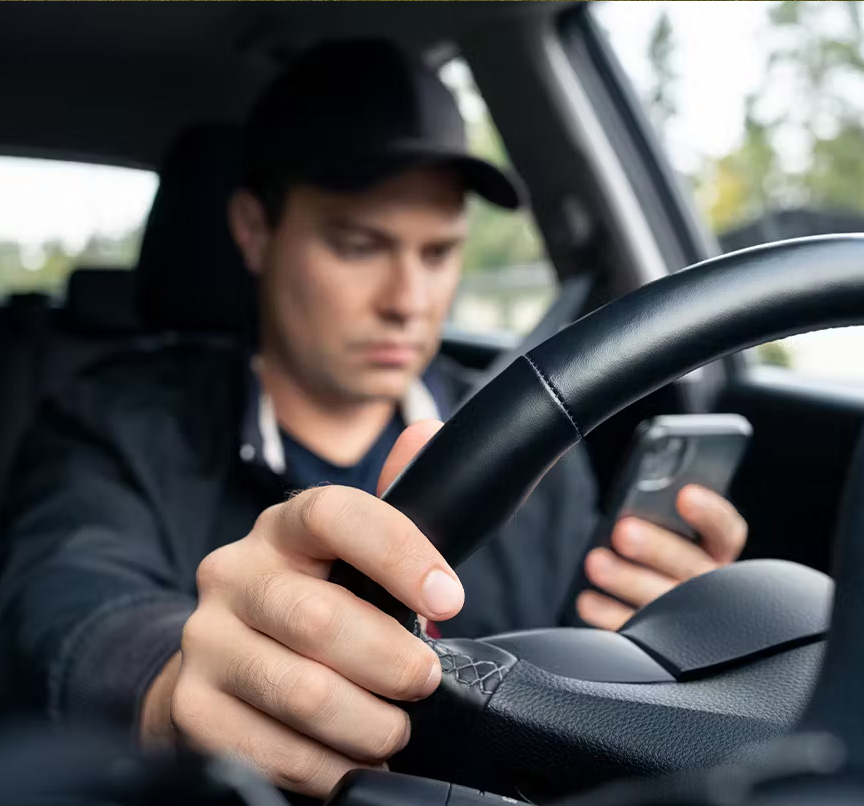
When another driver causes a crash because they were texting, they may be found negligent. But proving that distraction played a role isn’t always straightforward. Insurance companies may push back, and evidence can be harder to obtain without legal support.
Liability in these cases often rests on showing:
- The driver was using a phone at the time of the crash
- Their distraction directly caused the collision
- You suffered damages as a result
Police reports, witness statements, cell phone records, and even vehicle data (like black box info or GPS logs) can help build a strong claim.
Comparative fault considerations
Every state follows its own rules for assigning fault after a crash, and if you’re found partially responsible, it can affect how much compensation you’re able to recover. For example:
- Missouri follows a pure comparative fault rule. You can recover damages regardless of your share of fault, but your compensation is reduced by your percentage of fault.
- Kansas applies a modified comparative fault system with a 50% bar. If you're 50% or more at fault, you can’t recover anything. If you're less than 50% at fault, your compensation is reduced proportionally.
Comparative fault rules underscore the importance of working with an experienced car accident lawyer who will defend you and your claim against undue allegations of fault. This is exceptionally important in cases where both drivers were distracted, or where the insurance company tries to claim you weren’t fully paying attention.
The Hidden Costs of a Distracted Driving Crash
Many people expect to deal with a damaged car and a hospital bill. But texting-related crashes often cause more severe consequences. Distracted drivers may not brake in time or at all. The impact can be devastating.
Some of the more serious consequences include:
- Traumatic brain injuries
- Spinal cord injuries
- Internal injuries
- Broken bones and fractures
- Permanent scarring or disfigurement
In addition to physical recovery, you may face:
- Long-term medical care or rehabilitation
- Inability to work or lost future income
- Chronic pain or permanent disability
- Emotional trauma or PTSD
Insurance settlements usually don’t reflect the true long-term impact of your injuries and losses after a texting while driving crash. That’s why it’s important to consult with a lawyer and understand your rights before accepting any offer.
What To Do After a Texting-While-Driving Accident
If you’re recovering from a crash caused by a texting driver, you’ve likely already seen a doctor or started treatment. If not, don’t delay. Injuries from these crashes—especially to the head, neck, or back—can worsen over time. Prompt medical care protects both your health and your claim.
Once your medical needs are being addressed, there are other steps that can help safeguard your right to full compensation.
Hire a lawyer as soon as possible
Early legal help makes a difference. A personal injury lawyer can help preserve evidence, manage insurance communications, and protect your claim from common pitfalls. The longer you wait, the more control the insurance company has over the process.
Stay consistent with medical care
Don’t miss follow-up visits, therapy, or recommended tests. Gaps in treatment are often used to suggest your injuries aren’t serious. Keeping appointments supports both your recovery and the strength of your case.
Keep a recovery journal
Write down or record your pain levels, symptoms, sleep issues, and how your injuries affect work or daily routines. This record may be helpful later if the impact of your injuries is called into question.
Save all receipts and records
Track your medical bills, medication costs, transportation expenses, and anything else related to your injuries. These details can help show the true financial impact of the crash.
Avoid social media posts about the accident
Anything you share online could be used against you. Even seemingly harmless photos or updates can be taken out of context by insurance adjusters.
After a serious crash, you still have power in this process. Recalling and documenting any signs of distraction, like a driver holding their phone, failing to brake, or admitting they were texting, can make a difference. These small details, when shared with your lawyer early on, can help build a stronger case and improve your chances of recovering full compensation.
Texting While Driving Cases Are Often Easy to Undervalue
Not all distracted driving crashes are treated seriously, especially if the injury isn’t catastrophic or the driver wasn’t ticketed on the spot. Insurance companies may try to frame texting as a minor lapse in attention or claim there’s no proof the driver was using a phone.
Common reasons these cases get dismissed too quickly:
- Lack of obvious evidence: Unless a driver admits to texting or there's a witness, insurers may deny it happened.
- Minimizing injuries: Adjusters often downplay soft tissue injuries, concussion, and emotional trauma from “low-speed” crashes.
- Blame-shifting tactics: The insurer may argue you were also distracted or contributed to the crash.
If you don’t have legal help, getting pressured into a lowball settlement is easy, or the insurer may deny you any compensation. This is especially harmful when your injuries affect your long-term health, job, or quality of life.
Avoiding Common Mistakes After a Distracted Driving Crash
Even well-meaning people make missteps after an accident that can affect their claim. Here are a few of the most common mistakes to avoid:
- Talking to the other driver’s insurance adjuster without legal representation
- Failing to follow up with medical care or skipping appointments
- Posting about the crash on social media
- Downplaying injuries or avoiding treatment to "wait and see"
- Delaying legal advice until the claim has already been denied or closed
Once a settlement is accepted or a deadline has passed, there may be little room left to challenge the result. Early action is often the most effective way to protect your future.
FAQs About Texting While Driving Accidents
What is the deadline to file a claim after a distracted driving crash?
Every state has its own statute of limitations. In Missouri, you typically have five years to file a personal injury lawsuit (Mo. Rev. Stat. § 516.120), while Kansas gives you two years (Kan. Stat. § 60-513). However, shorter deadlines normally apply in every state if a government vehicle or agency is involved.
How much does it cost to hire a personal injury lawyer?
Most personal injury lawyers work on a contingency fee basis, meaning they don’t get paid unless you win. That fee is usually a percentage of your settlement or verdict. Initial consultations are typically free, including at firms like Presley and Presley Trial Lawyers.
How can I prove the other driver was texting?
It can be difficult without direct evidence, but there are several ways to prove it:
- Police citations or crash reports
- Eyewitness accounts
- Cell phone records (with subpoena)
- Surveillance or dashcam footage
- Admissions at the scene
A lawyer can gather and preserve this evidence.
Will the driver be charged criminally?
In many cases, no, especially if the accident didn’t cause severe injuries or fatalities. However, some states do allow criminal charges or license penalties if texting while driving leads to serious harm. Civil cases for compensation are separate from criminal proceedings.
Presley and Presley Trial Lawyers: Trusted Advocates for Distracted Driving Victims
When someone’s careless decision to send a text leaves you injured, the path forward can be long and difficult. You may be in pain, missing work, and unsure what comes next. You need someone who understands what’s at stake and has the resources and experience to take on the insurance companies and fight for what’s fair.
Presley and Presley Trial Lawyers is a boutique personal injury law firm based in Kansas City, Missouri, representing clients throughout Missouri and Kansas. We focus on high-value catastrophic injury and wrongful death cases, including distracted driving crashes with serious consequences.
If you or a loved one were injured by a texting driver, don’t settle for a quick payout. Call (816) 931-4611 or contact us online to schedule a free consultation. We’ll help you understand your options and pursue the compensation you need to recover and rebuild.